Monday, April 8, 2013

Week 26


LE studied the work of Austrian artist, Gustav Klimt.  They created paintings inspired by his work, The Tree of Life.

"Tree of Life" by Ryder


ME’s final project with bilateral symmetry uses color opposites to create optical effects.


To wrap up their study of European Renaissance art, UE took on the challenge of doing a realistic drawing of a live model focusing on capturing the right perspective, proportions, and dimensions.


AC kicked off the spring season with these bright and colorful multimedia paintings.

Thursday, April 4, 2013

Week 25


EC, along with the upper school classes,  have spent a significant amount of time doodling this year.  You will see this in the up and coming yearbook!  Doodles are often overlooked, but should be seen as integral to the process of an artist.   “For children, doodling is their way of expressing their ideas and showing their perceptions in visual form. It comes from a need to give physical form to one’s thoughts. “  To understand more about the importance of doodling, please read this wonderful article in Smashing Magazine. 


LE studied the work of the Spanish Catalan artist, Joan Miro.  While listening to Spanish music with layers of moods, the students freely drew lines that formed shapes to illustrate what they were feeling . They then painted in the shapes in the style of Miro.


To continue their study of bilateral symmetry, ME created theses letternets.  Letternets are  mirror images of their names written in cursive on a folded paper and then cut out.


ME also visited the Nashville Children’s Theater to see the performance of, The Wind in the Willow.  This production is adapted by Scot Copeland and Paul Carrol Binkley
and based on the book by Kenneth Grahame and the songs of Gilbert and Sullivan.


UE continued their study of European Renaissance art focusing on the human figure drawings of Leonardo Da Vinci.  After reviewing his sketches and drawings, the students practiced drawing each other focusing on perspective, proportion, and dimension.


UE also visited the Nashville Symphony to see the performance of, The Red Violin, conducted by Leonard Slatkin.


MS completed their Alexander Calder inspired sculptures.


Friday, March 22, 2013

Week 24

The Nashville Opera brought their performance of Little Red’s Most Unusual Day, an operatic twist on the traditional Little Red Riding Hood story, to Abintra. Upper Elementary Guide Maria (pictured far right) made a cameo as a lumberjack!


ECA friends experimented with clay.  This work helps strengthen the hand muscles for writing and performing practical life activities.


ECB friends reviewed a book of children from different cultures and chose a child to create a paper doll using fabric, glue, and crayons.


ECC friends experimented with watercolor paint by painting Vincent Van Gogh’s famous painting, Sunflowers.


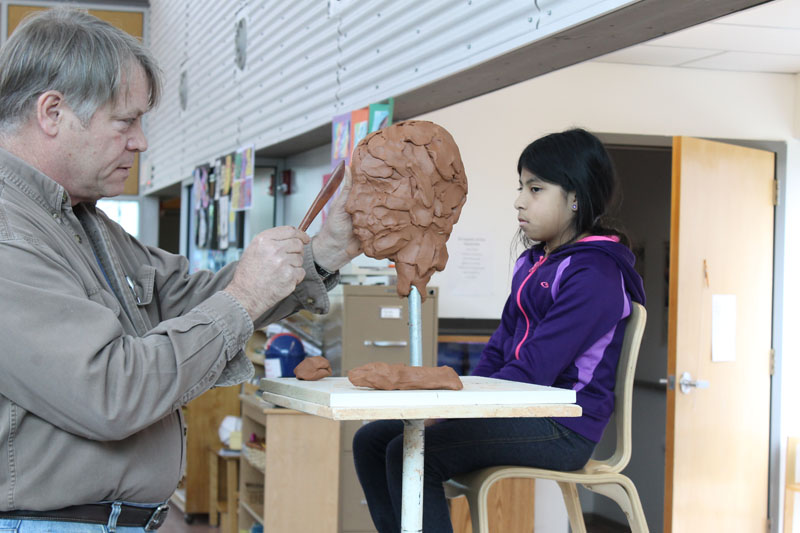
ME was honored to have the Nashville sculptor, and former Abintra parent, Alan LeQuire, visit their classroom to teach them about sculpting.  He did a demonstration by starting an armature of a student’s head for another student to finish. LeQuire is best known for his colossal sculptures, Athena Parthenos, the largest indoor sculpture in the western hemisphere and Musica, one of the largest bronze figure groups in the world.


ME visited TPAC to see the performance of Baobab.  In Western Africa, under a blazing sun stands a huge and ancient Baobab tree. The Griot tells the legend of the little boy born from this tree. Making wonderful use of African-inspired puppets, costumes, and live music on stage, Théâtre Motus creates a world where one child has the power, and only the village adults can guide him to use it wisely.


UE continued their study of European Renaissance art by creating a realistic painting of an orange using oil paint.

Drawing by Cora

Oil Painting by Seraina


MS started their Calder influenced sculptures.  The majority of students took on the challenge of creating a mobile.


Monday, March 18, 2013

Week 23

EC students have been working on matching sets of paintings from different European artists such as Matisse, Miró, Renoir, and Van Gogh.


LE created these beautiful landscape paintings using watercolor and the paper they made in their previous art class.
Landscape on handmade paper by Rachel


ME was introduced to Wycinanki, or Polish paper cutouts, representing the Tree of Life. The original Polish designs usually included birds, flowers, hearts and lacey designs and were cut with sheep shears. The students used color opposites for contrast when gluing the trees on a backing.

Tree of Life by Caroline


During the European Renaissance, painters moved from using egg tempura to using oil paint. UE kicked off their study of Renaissance painting by experimenting with both. They enjoyed making their own egg tempura by mixing the yolk with pigment. 


UE also visited the Schermerhorn Symphony Center to see the dress rehearsal of the Nashville Symphony performing Tchaikovsky and Copland.  Copland’s colorful El Salón México opened the performance with lively Latin rhythms. Full of dramatic, explosive music, Tchaikovsky’s Fifth Symphony is a powerful masterpiece that finds the great Russian composer triumphing over adversity


MS studied the sculptures of Alexander Calder. After viewing and discussing his mobiles, wire sculptures, and stables, each student designed a mobile influenced by his work.


AC has been practicing their weaving skills.


Monday, March 4, 2013

Week 22


ECA students learned about the work of  Agnes Martin, an American/Canadian abstract expressionist.  The students created drawings influenced by her work.

Drawing by Addie


ECB experimented with paint by placing a couple of paint drops (two colors) on a piece of paper and then fold the paper in two. When they open it they see a beautiful art creation made by the two colors.

Painting by Elizabeth


ECC has spent a lot of time working on Chinese lanterns. They have been talking about the Chinese New Year and the importance of the lanterns in New Years celebrations. We made lanterns using construction paper that the children decorated with crayons. After decorating, students cut slits in the paper and, with some help from a guide or older friend, stapled the sides to create a lantern. We enjoyed hanging the lanterns in our classroom as we look forward to the "new year"!


LE made recycled paper from the paper shredded in the office.  They enjoyed seeing the process of soaking the paper and putting it in the blender to create the pulp.  They each had a turn of dipping a screen in the water of pulp, flattening the pulp with a board, and soaking up the water with a sponge.  Some students chose to embed flower petals from Abintra’s greenhouse into the pulp.  


ME has been studying aerial views, looking at a wonderful book called Earth from Above. They created drawings, done in watercolor pencils, that are designed to be connected.  They call them Rivers and Roads. They took their inspiration from organic shapes made by the interaction of earth, water and weather as well as the patterns made by humans. 

"Rivers and Roads" by Aidan


UE studied visual metaphors through the photographs of Diane Arbus and Dorothea Lange.  The students developed a personal metaphor and created a photograph to illustrate it. 

"Honesty" by Maggie


UE ME, UE, and MS visited the Frist to see the exhibition, Rembrandt and the Dutch Golden Age: Highlights from the Detroit Institute of Arts.  This exhibit presents the greatest Dutch masterpieces by painters such as Frans Hals, Jacob van Ruisdael, Jan Steen, Gerard Ter Borch, and the incomparable Rembrandt van Rijn.

Gerard Ter Borch (Dutch, 1617-1681). Lady at Her Toilette,


Abintra was pleased to welcome The S.O.U.L Singers - Singers Of United Lands, who performed for us on campus.  S.O.U.L Singers is a vocal quartet- of which all four members are from a different continental region of the world!  They perform songs, which are native to their home countries while offering interactive multicultural workshops, presentations, and performances for audiences of ALL ages. 


Friday, February 22, 2013

Week 21


ECA has been working on creating their very own Superimposed Geometric Figures. By choosing two colors to form a pattern, friends experience gradations in two dimensions. They love this lesson! 


ECB experimented with an art technique Claudia did when she was a child. They place four nuts on a piece of paper, then place a strainer covering the nuts. With a paint brush they paint all over the strainer creating a dust of paint arount the nuts. When they remove the strainer and the nuts they see the nuts stamp on the piece of paper.


ECC is practicing using reusable art paper to make new creations. Collaging is a way to create unique pieces that exhibit contrast in color and shape. The act of gluing helps strengthen the hand for writing and hand eye coordination.


LE had a geometry in art lesson by reviewing the tessellations of M.C. Escher.  They created their own tessellation designs and painted them in a pattern of their choice. 


Tesselation by Max


Local artist, Stacey Irvin, visited Abintra to do a presentation of her work for LE, ME, UE, and MS.  Stacey is an award-winning world and humanitarian photographer.  She presented her photographic journey through China, Ecuador, Guatemala, and Kenya. Stacey’s presentation portrayed the visual metaphors in photography that UE and MS have been studying through the work of Diane Arbus and Dorothea Lange


Our aftercare artists have been thoroughly engrossed with the construction of miniature treehouse sculptures. Utilizing a variety of materials, such as logs, branches, wood scraps, and wire, each student created highly imaginative and unique mini environments. Some treehouses included animals, swings, hammocks, ladders, and elevators. One artist built a space called "The Disco Room", and yes, that is a room constructed solely for the purpose of disco dancing! 
 

Tuesday, February 5, 2013

Week 20

ECA received a group lesson with Dave about the origin of snowflakes. Then they reviewed the colors of the crystals and observed which colors they could see in a snowflake. Patricia then presented a cutting exercise lesson, taking a piece of paper (square) and folding into 4. Then she proceeded to make the cuts. When she finished,  Patricia opened the paper and they could see the snowflake!! They loved the activity and worked on it for three weeks every day!


ECB’s printmaking work was created using a stamp made by wrapping strings around a circular container.

Printmaking by Zoe


ECC students continue to work with primary colors. They select pieces of string, dip them in paint and place them onto paper to create pieces of art. They have been amazed to see what happens when primary colors mix together. It has also been fun to explore other techniques of painting besides the typical paintbrush.


To align with their study of land and water forms, LE created paper mache globes.  After their globes dried, they drew the continents and painted in the land and water forms.


ME created these print paintings influenced by a previous project called Rivers, Roads and Rails, a series of connectable drawings in pencil.  The rivers and roads divided their pages into fields, playgrounds, neighborhoods and so on.  For these paintings they drew lines to divide space and stamped with sponges, pencils, cardboard and straws.


UE finished their one-point perspective drawings.

One-point perspective by Cora


MS studied visual mataphors through the photographs of Diane Arbus and Dorothea Lange.Then students developed a personal metaphor and created a drawing or photograph to illustrate it. 

Photograph by Kealey


After looking at Edvard Munch's famous painting, The Scream, the Aftercare Art students created artwork using a photograph of their own choice of expression.